
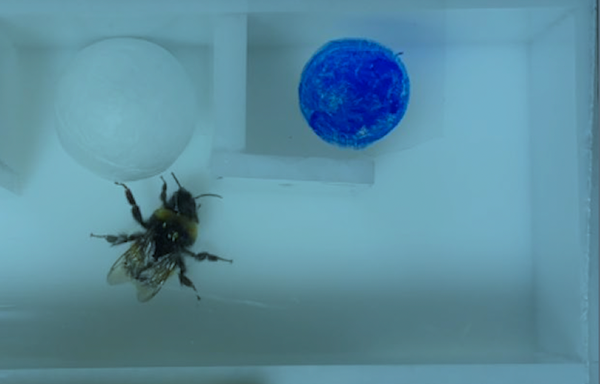
Contrary to their name, bumblebees are no bumbling oafs. A new study published in Science on Thursday found that these bees utilized tools to solve complex problems to win a sugary treat, even if they had never been trained to use the tools in any context. In fact, some of the bees even cheated—skipping the problem altogether—to reap the reward, the researchers found.
This isn’t the first time bumblebees have been seen to use tools to get what they want. A 2016 study, for example, found that such bees could learn to pull a string to receive a reward—and that untrained bees could learn this trick from their more educated peers. Still, it adds to the evidence that creative problem-solving and tool use aren’t just the domain of larger-brained animals, such as birds and apes. Bumblebees’ brains are relatively primitive—they have around one million neurons, compared with the 86 billion or so in human brains—yet the new experiment indicates that complex problem-solving doesn’t necessarily require complex gray matter.
“The number of neurons is not correlating with cognitive abilities,” says Olli Loukola, a behavioral ecologist at the University of Turku in Finland and a co-author of the new study. “It might be that animals with bigger bodies require bigger brains, or it could be that animals that need more long-term memory require bigger brains, whereas bees are living in rapidly changing environments.”
On supporting science journalism
If you're enjoying this article, consider supporting our award-winning journalism by subscribing. By purchasing a subscription you are helping to ensure the future of impactful stories about the discoveries and ideas shaping our world today.
In a series of experiments, bumblebees were divided into groups and put through a series of tests, all involving the same basic setup: a small chamber with several pits in the floor. If the bees rolled a Styrofoam ball into the correct pit, they could climb onto it to drink from a sugar-filled fake flower on the ceiling of the chamber.
The chamber was built so the bees couldn’t hover under the flower to drink from it. Nor could they reach it from standing on the floor. Instead the bees had to get the ball into the right pit to climb on top and avoid all the other pits. The test was specifically designed to be unlike anything the bees would face in their natural environments. Apparently bumblebees really enjoy rolling balls for fun, but there is no evidence that bees in the wild might roll a ball into place to reach a flower for food.
“We weren’t interested in instincts in their behavior; we were interested in their flexibility in decision-making,” Loukola says. “You need to have something that’s not natural for them. They don’t really need to roll any objects when they’re foraging.”
The bees weren’t taught how to use the ball to get to the flower. All they knew going into the experiment was that the flower had a sugary treat inside and that the ball was movable. In all, 16 of the 22 bees the researchers tested successfully rolled the ball into the right pit and got to enjoy a meal.
Not every bee was successful, but that doesn’t necessarily mean there’s such a thing as a stupid bumblebee, Loukola says. Bees may be like people, he says: some might lack motivation, or they might be too stressed or hungry to solve the puzzle. And some of the bees that technically failed the test may have actually outsmarted their contemporaries—by learning to work smarter, not harder.
“We didn’t report this in the paper, but one very cool thing we observed that couldn’t be recorded as a success was: we found some individuals cheating,” says Akshaye Bhambore, the study’s lead author and a doctoral researcher at the University of Oulu in Finland. “The experiment was designed in a way that they cannot fly and drink at the same time, because the height was too low, so they were required to use the ball as a tool. A very few individuals figured out that they don’t need to use the ball at all and that they could just hang off the ceiling and try to drink from the flower.”
The researchers are already planning new experiments that will enable them to better monitor the bees physiological responses to problem-solving. These could help reveal whether bumblebees experience anything akin to an “aha! moment,” much as a human does when working out the best way to a desired solution. There’s also hope that more can be learned about how much bees really understand about the physical world around them and how they can alter it to their own benefit.
“The next steps would be to see if they really understand the physical properties of the objects themselves,” Bhambore says, “to see if they can understand that this object differs from others and that they need to use one object to perform the task versus other, nonfunctional ones.”
