
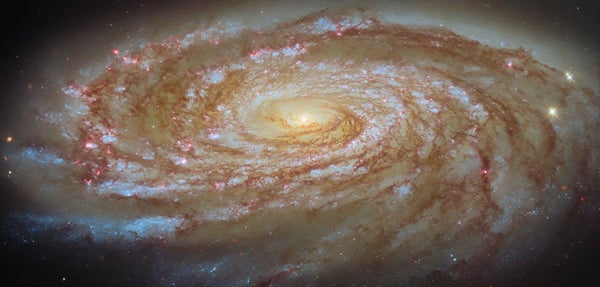
NASA's Hubble Space Telescope snapped a delicate dance of celestial bodies in a new image of a distant galaxy that’s on a course toward the center of a large cluster of other galaxies.
The photograph of the galaxy Messier 88 (M88), also known as NGC 4501, shows the bright glow created by its central black hole—which is estimated to be around 100 million times more massive than our sun—as it sucks up gas and dust. The numerous bright red dots strewn around M88’s spiral arms are old stars, while the pink and blue represent star clusters and dust clouds.
The galaxy itself is large, stretching around 130,000 light-years in diameter, but it’s just one part of the larger Virgo Cluster, which is made up of more than 1,000 galaxies. As M88’s stars spin around its central black hole, the galaxy itself is twirling around the cluster’s center. Its journey is bringing it closer to both the middle of that swarm and some of the other individual galaxies in the cluster.
On supporting science journalism
If you're enjoying this article, consider supporting our award-winning journalism by subscribing. By purchasing a subscription you are helping to ensure the future of impactful stories about the discoveries and ideas shaping our world today.
Eventually, after some 200 million to 300 million years, M88 will reach its closest point to the neighboring galaxy Messier 87. The gravitational effects of the two galaxies’ proximity are already being observed. In the new Hubble image, some of the gas on the outer edge of M88 can be seen compressing and piling up. M88 also appears to have less cold gas, which fuels star formation, than should be present in a galaxy of its size. This is all because of a process known as ram pressure stripping, where the gravitational pull of another celestial body strips gas away.
Despite being located about 60 million light-years away in the constellation Coma Berenices, M88 is a fairly bright object in the night sky. The galaxy was discovered by its namesake, astronomer Charles Messier, in 1781. It was a particularly productive day for Messier—M88 was just one of nine celestial objects he discovered that night.
