
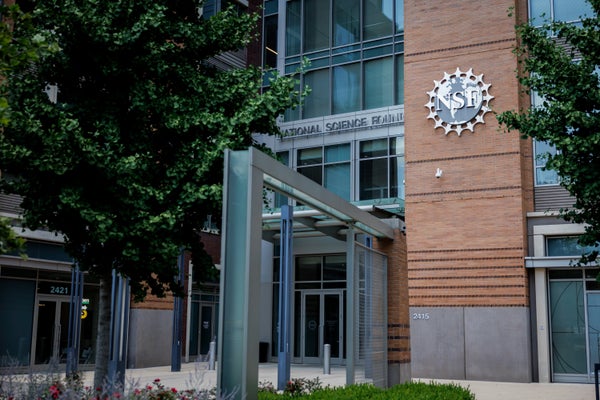
On Monday some 1,500 members and supporters of the U.S. National Academies of Sciences, Engineering, and Medicine denounced the White House’s dismissal of the National Science Board (NSB), a long-standing expert board that oversees the National Science Foundation (NSF).
The NSB was fired without notice on April 24. In the open letter, the signatories—who include 37 Nobel Prize winners—said the NSB’s firing was “an alarming attack on the ability of the US to engage in basic and applied research.” They called on Congress to oppose the move.
Since 1950 the NSF has funded U.S. basic research, from astronomy to vulcanology, under guidance of the board, which has historically been filled with “eminent” scientists. The board is designed to be apolitical, and members are appointed to six-year terms by the president. It is required by statute to approve the NSF’s budget, which was $9 billion in 2026. The White House said last year, however, that research grants will now be approved by political appointees. The administration has also proposed to cut the NSF’s budget by about 50 percent in 2027 and to dissolve its social sciences arm.
On supporting science journalism
If you're enjoying this article, consider supporting our award-winning journalism by subscribing. By purchasing a subscription you are helping to ensure the future of impactful stories about the discoveries and ideas shaping our world today.
Despite Congress overriding similar calls from the administration in January, the NSF had largely stalled its distribution of grants into April, according to Nature. Four agency civil servants, speaking anonymously to Scientific American because of fear of retribution, say funding has largely been held up except for seemingly favored research into artificial intelligence, quantum computing and related technologies.
The board’s ouster comes amid a purge of independent scientific and research groups whose purpose has been to advise the federal government’s science and health policies. Other moves include Secretary of Health and Human Services Robert F. Kennedy, Jr.’s 2025 decision to fire all the members of an influential vaccine advisory committee; Kennedy recently said he intends to overhaul the U.S. Preventive Medicine Task Force, which makes recommendations for health insurance coverage for medical tests. And in March 2026 the White House revealed that the President’s Council on Science and Technology, long staffed with academic experts, is now led by tech industry figures such as Meta’s chief executive Mark Zuckerberg and Oracle’s Larry Ellison—just one academic is on the council.
The NSF has taken decades to build and fine-tune its practices and the “vital” university partnership that supports much of U.S. science, says physicist Neal Lane, who was formerly an agency director during the Clinton administration. “NSF has become the model for other nations around the globe, including China, but the Trump administration has been destroying that edifice in a mere 18 months,” Lane says.
The White House has sought to justify the dismissal of all 22 NSB members (typically there are 25—the board was lacking two ordinary members and an agency chief member) by pointing to a 2021 Supreme Court patent court ruling that limits the power of federal officials who are not appointed by the U.S. Senate. Still, the board had emphasized after that high court decision that its positions were recommendations, not orders. In 2011 Congress had removed the requirement for Senate confirmation of NSB members, who work part-time and are only compensated for their time on the board.
In February the Trump administration announced that it would nominate hedge fund investor Jim O’Neill to lead the NSF. He will be the first nonscientist to head the agency if he is confirmed by the U.S. Senate. “If, as I hope, Congress wishes to rebuild that NSF infrastructure, Jim O’Neill is not the person to do so, given his almost complete lack of scientific credentials,” Lane says. He urged the U.S. Senate to reject O’Neill’s nomination and demanded that the White House name an acknowledged scientific leader “with the necessary political acumen” as NSF chief.
“NSF is supposed to be an independent agency, and the board is supposed to provide that independence,” says Colette Delawalla of the science advocacy group Stand Up for Science, which helped organize the open letter alongside an unofficial group of National Academies experts. The group fears the administration will seek to fill the board with industry figures who may prioritize their own firms’ agendas instead of basic science. “The dismissal of the board might seem like a bureaucratic move, but it is a bellwether of the administration removing expertise and independence from our democracy,” Delawalla says.
Editor’s Note (5/11/26): This story has been updated with comment from Neal Lane.
