
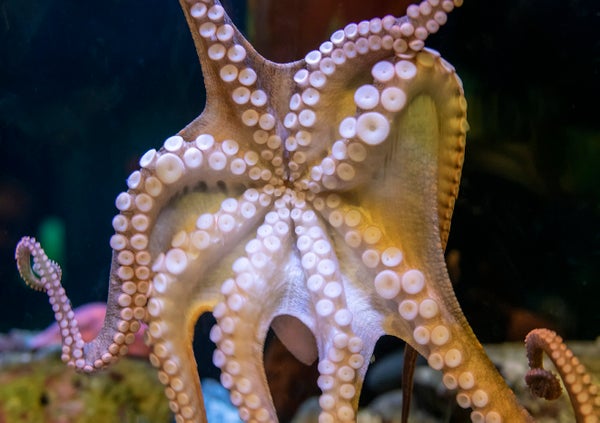
Octopus sex hinges on a bizarre anatomical trick. In lieu of a penis, the male has a special mating arm called a hectocotylus. He feels around with it inside the female’s mantle—a bulbous structure behind the eyes that houses all of an octopus’s organs, including reproductive ones—until he finds her ovary. He then slides a sac of sperm down his arm and deposits it. But the male can’t actually see what he’s doing. So how does he know when he’s found the right spot to send in the sperm? The answer, it turns out, lies in the arm itself.
In a study published in Science, researchers show that the male California two-spot octopus’s mating arm can sense sex hormones emanating from the female’s oviduct, the passage to the ovary.
Chemotactile receptors in octopus arm suckers let the arms “taste” their surroundings through touch. But octopuses typically don’t use the hectocotylus in hunting or seafloor exploration; instead males hold it close to their body when they’re not mating. Nevertheless, this appendage, like the octopus’s other seven, comes loaded with receptors, says Harvard University molecular biologist Pablo Villar, co-lead author of the paper.
On supporting science journalism
If you're enjoying this article, consider supporting our award-winning journalism by subscribing. By purchasing a subscription you are helping to ensure the future of impactful stories about the discoveries and ideas shaping our world today.
To understand the purpose of these receptors, Villar and his colleagues coaxed a pair of California two-spot octopuses to mate in the laboratory. Because octopuses can be aggressive, the researchers installed a divider in the tank with a few small holes so the pair could warm up to each other. This arrangement might seem ill-suited for lovemaking, but surprisingly, the male simply reached across the barrier and got busy. The investigators tested four more mating pairs and got the same result—even in total darkness. “They made it seem super, super natural,” Villar says.
Octopuses are highly visual creatures that communicate through body language and color changes. But these flourishes don’t seem essential for mating. “They were able to do it with no visual cues,” Villar says, “just by touching.” Female octopuses, he and his team theorized, must release some kind of chemical signal to guide males in.
They found that the octopus oviduct produces enzymes that are used to make the sex hormone progesterone. This hormone seems to attract the hectocotylus: when the researchers attached tubes to the holes in the tank divider, each coated with a different chemical, males were quickly drawn to the one containing progesterone. Even amputated mating arms responded to progesterone but not to other molecules.
Many animals rely to some extent on the detection of sex hormones for mating. But the organ that senses those hormones is usually separate from the one that delivers the sperm; in male octopuses, the hectocotylus does both. That way, says molecular biologist Nicholas Bellono, a co-author of the study and Villar’s postdoctoral adviser at Harvard, “you make sure at the site of release that that’s the exact spot.”
Females of different octopus species may have unique chemical signatures, and males’ receptors may be tuned to respond only to the right blend of hormones. If so, this mating strategy could help keep species separate and potentially give rise to new ones. “Species boundaries are shaped not only by the genes organisms carry but by the molecular systems that determine how organisms perceive one another,” Anna Di Cosmo, a zoologist at the University of Naples Federico II in Italy, writes in a commentary accompanying the new study. “By reshaping perception, evolution reshapes reproduction, which reshapes the tree of life.”
Elena Gracheva, a neurophysiologist at the Yale School of Medicine, who was not involved in the new study, says it’s too soon to tell whether all octopuses mate in this way or what role these sensory systems may play in evolution. She is impressed by the thoroughness of the research, however, which began with a naturalistic observation and proceeded all the way to fine-grained molecular analyses. “You have very striking animal behavior, and then you’re going down to the single molecule, which I think is beautiful,” she says. “But I would say that this is just the beginning of the discovery.”
