Space & PhysicsAugust 24, 2016
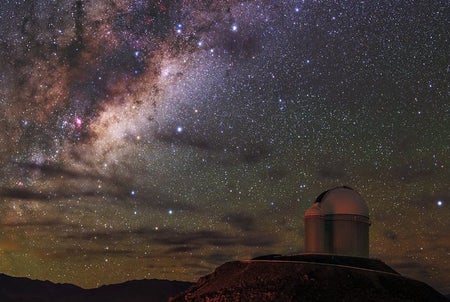
Proxima Centauri Just Became Our Gateway to the Cosmos
Astronomers obtain convincing evidence of a potentially habitable world around our nearest neighboring star—this could change everything
Proxima Centauri Just Became Our Gateway to the Cosmos
Astronomers obtain convincing evidence of a potentially habitable world around our nearest neighboring star—this could change everything
3 Cosmic Mysteries--No. 1
What are some of the most intriguing and unexpected puzzles about the universe?

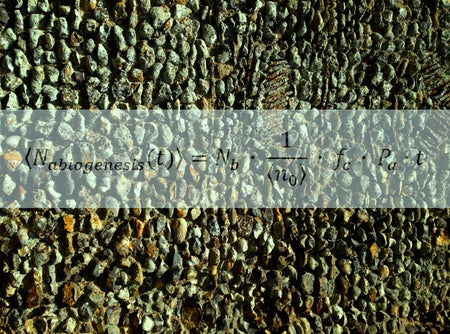
An Equation for the Origins of Life
Can we connect the microscopic and macroscopic factors involved in starting life on a planet?
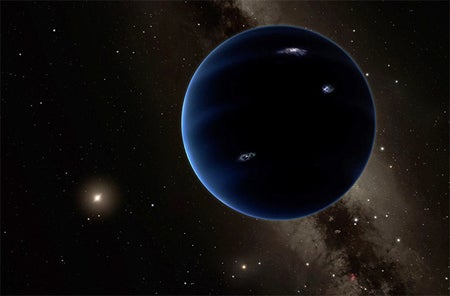
5 Questions and Answers about the Proposed Ninth Planet
A new analysis of outer solar system orbits suggests that there really could be a hitherto unseen giant planet orbiting far from the sun—but what are the implications?
To Play or Not to Play the Exoplanet Name Game?
Campaigns to name exoplanets seem like Shakespearean farce
A Tale of Interstellar Progress
Interstellar travel may present some unforseen problems in this short fiction

Just Another Cloudy Morning on a Hot Exoplanet
Astronomers use Kepler telescope to study weather on Jupiter-size planets beyond our solar system
Looking for Life In Our Soggy Solar System
Scientists are finding liquid water, the cornerstone for life as we know it, in surprising nooks and crannies of the solar system. Following Wednesday's news that there seem to be hydrothermal vents churning away in the warm, alkaline seas inside Saturn's moon Enceladus, researchers announced airtight evidence yesterday that Jupiter's moon Ganymede also has a [...]
A Blizzard of Astrobiology
Astrobiology has one key advantage when it comes to tooting its own horn – it can lay claim to a diverse range of scientific research as being relevant to the study of life in the universe.
Planet Hunters Bet Big on a Small Telescope to See Alien Earths
In 1990, NASA's Voyager 1 spacecraft briefly looked back from its journey out of the solar system, capturing a view of the faraway Earth. Carl Sagan called it the "pale blue dot." From more than 6 billion kilometers away, beyond the orbit of Pluto, it seemed remarkable that our planet was even visible.
Notes From The Frontier: Life’s Origins
I spent some of last week at a fascinating and lively symposium on the origins of life and the search for life in the universe, held at the Earth-Life Science Institute (ELSI) at the Tokyo Institute of Technology.
The Top Ten Space and Physics Stories of 2014
From humanity’s first, flawed foray to the surface of a comet to the celebrated discovery of (and less celebrated skepticism about) primordial gravitational waves, 2014 has brought some historic successes and failures in space science and physics.